
Nature is unpredictable and severe weather often poses the biggest threat to trees. The temperature of a lightning flash can be 30,000C – five times hotter than the sun – and it doesn’t take a tree expert to realise this can inflict significant damage.
But some trees can and do recover from such an injury, the problem for tree surgeons is predicting the extent of the damage. And the future life expectancy.
The ability of a tree to withstand a lightning strike very much depends on the species and moisture content. It also depends on the health of the tree to start with. A healthy tree should be able to cope with such an injury better than one already suffering disease or decay but the intensity of the strike will be the deciding factor.
A tree can be killed instantly by a lightning strike or significantly weakened. Anything tall including buildings and statues are at risk of lightning damage. But trees are a common victim because of the moisture they contain within the tissues inside the tree bark. This makes them much better conductors of electricity. The electrical current places the tree’s inner cells under intense heat which can cause the drier bark on the outside to explode off in large chunks.
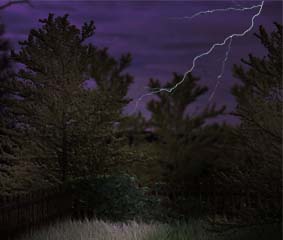 Some species are more prone to lightning strikes than others. These include the sequoia, poplar, cedar, and Douglas fir. Some trees can explode from core and some suffer a longer split down the trunk.
The damage can sometimes be lessened if the outside of the tree is rain soaked as the current may instead be limited to the outside of the trunk. However, severe lightning bolts have split trees in two and caused them to set fire from the inside.
Any tree which has been struck by lightning should be assessed to ensure it is still safe and doesn’t pose a threat to anybody. This examination should only take place once the storm has subsided and there is no threat of further lightning. More people are struck by lightning close to trees or water than anywhere else.
A qualified tree surgeon will be able to safely assess the safety of the tree. Any jagged or insecure branches will be removed immediately and the appointed tree expert will be able to determine the general health of the tree.
It is very difficult to determine how well a tree will fight back from a lightning strike and sometimes a ‘wait and see’ approach is the only option. Injured trees will be more prone to insects, disease and decay so while they might initially survive the lightning strike, the damage could worsen as the months or years go by.
Any tree which is immediately dangerous to people or property should be removed instantly.
It is possible to protect historic trees or trees which are close to properties by implementing a lightning protection system. Such a system uses copped conductors which are linked to a ground rod to route any electrical charge to the earth where the energy is dispersed. This reduces tree damage and the possibility of side flashes. This is a situation where lightning jumps from a tree to more conductive materials on a property close by.
